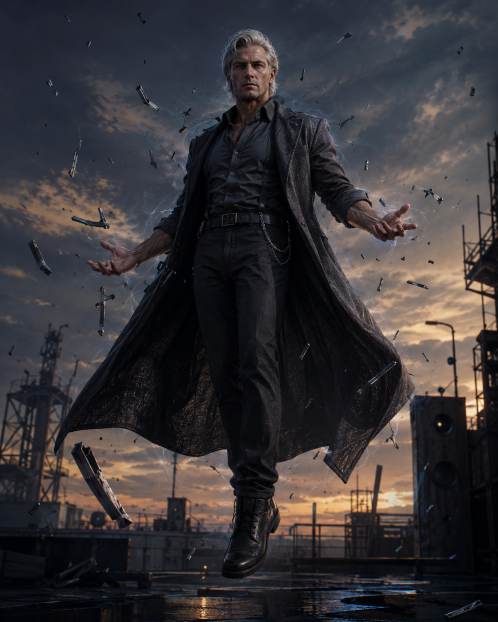
Erik Lehnsherr
Name Erik Lehnsherr
Position Master of Magnetism
Character Information
| Codename | Magneto | |
| Gender | Male | |
| Species | Mutant (Homo superior) | |
| Age | 56 (after Asteroid M event - 47) | |
| Affiliations(s) | Brotherhood of Mutants (Founder and leader); Avalon/Asteroid M (Founder and former ruler); formerly Genosha |
Physical Appearance
| Height | 6'2" | |
| Weight | 190 lbs | |
| Hair Color | Silver-white | |
| Eye Color | Blue-grey | |
| Physical Description | Erik stands 6'2" with a lean, powerful build and the controlled bearing of a man accustomed to commanding a room before he speaks. Though physically restored to his late forties, his silver-white hair and sharply defined features retain the weight of a much longer life. His blue-grey eyes are intense and watchful, capable of seeming cold at a distance, though they reveal far more when his guard slips. Every movement is deliberate, economical and quietly assured, lending him an imposing presence without the need for overt displays of strength. |
Family
| Spouse | Magda Eisenhardt (wife, deceased) | |
| Children | Anya Eisenhardt (daughter, deceased) Wanda Maximoff (daughter, alive) Pietro Maximoff (son, alive) Lorna Dane (daughter, alive) |
|
| Father | Jakob Eisenhardt (father, deceased) | |
| Mother | Edie Eisenhardt (mother, deceased) | |
| Brother(s) | ||
| Sister(s) | Ruth Eisenhardt (sister, deceased) | |
| Other Family | Erich Eisenhardt (paternal uncle, deceased) |
Personality & Traits
| General Overview | Erik Lehnsherr, better known as Magneto, is one of the most powerful and controversial mutants alive. A survivor of the Holocaust and founder of both the Brotherhood of Mutants and Avalon, he has dedicated his life to ensuring that mutantkind will never again be left defenceless against persecution. His methods have ranged from rescue and sanctuary to revolution, conquest, and acts of devastating force. Following a catastrophic systems failure aboard Asteroid M, Erik’s body was physically restored to his late forties, though his memories, convictions, and accumulated experience remain unchanged. No longer content to rule from orbit, he has returned to Earth with renewed strength and a broader vision for mutant survival. He remains intelligent, cultured, fiercely protective, and uncompromising in his belief that mutants must secure their own future rather than depend upon human tolerance. |
|
| Mutant Power(s) | Electromagnetic Field Manipulation/Magnetokinesis: (5) = Erik can generate, perceive, shape, and manipulate magnetic fields and electromagnetic energy. His power is most commonly expressed through his control of metal, allowing him to lift, reshape, dismantle, compress, or propel metallic objects ranging from small components to vehicles and massive structures. His precision allows him to manipulate individual mechanisms, disarm multiple opponents, redirect projectiles, and construct weapons, restraints, platforms, or armour from nearby metal. Erik can use magnetic fields to fly, carry others, and generate powerful force fields capable of resisting physical attacks, explosions, projectiles, and some forms of energy. He can also sense metal and electrical activity around him, interfere with machinery, redirect electrical currents, and release electromagnetic pulses capable of disabling technology over a wide area. Although metal is the most visible expression of his mutation, Erik’s true power is control over electromagnetism rather than metal alone. Ferromagnetic materials such as iron and steel are easiest for him to manipulate, while non-ferrous metals, electrical systems, and biological electromagnetic activity require greater concentration and precision. Limitations: * Concentration: Erik can manipulate numerous objects and maintain several effects at once, but each additional demand divides his attention. Telepathic interference, sensory overload, serious injury, exhaustion, or emotional instability can weaken his control. * Physical Strain: Moving enormous structures, maintaining extensive force fields, or affecting regional magnetic systems places considerable strain upon him. Excessive use can cause migraines, bleeding, cardiac stress, unconsciousness, or temporary loss of power. * Environmental Dependence: Erik remains powerful without nearby metal, but environments rich in metallic material give him significantly greater options and leverage. Weak or unstable magnetic conditions can hinder his flight and larger feats. * Electromagnetic Pulse: Large electromagnetic pulses cannot easily distinguish between hostile and allied equipment. Medical systems, communications, vehicles, and life-support technology within range may all be disabled. * Biomagnetic Control: Erik can detect and interfere with the electrical and magnetic activity of living bodies, but this is difficult, dangerous, and requires exceptional precision. He cannot simply manipulate blood as though it were solid metal. * Telepathic Defence: Erik’s helmet protects him from most direct telepathic intrusion while worn. Without it, he possesses no natural immunity to telepathy, and the helmet offers no protection from magic, emotional manipulation, or unconventional psychic attacks. |
|
| Profession(s) | Revolutionary leader; political activist; scientist and engineer; former head of state of Avalon and Genosha. | |
| Strengths & Weaknesses | Erik possesses an extraordinary intellect, combining scientific knowledge, political instinct, and strategic foresight with decades of lived experience. He rarely enters a situation without considering its broader consequences and is exceptionally difficult to deceive. That same certainty can harden into arrogance, however. Once Erik believes he understands the shape of a conflict, he can dismiss opposing views as naïve, cowardly, or wilfully blind, even when they expose flaws in his reasoning. He is fiercely protective of mutantkind and will place himself in danger without hesitation to save mutants from persecution, exploitation, or death. His devotion has inspired loyalty because it is not merely rhetorical; Erik acts when others hesitate. Yet his concern is often directed towards mutants as a people rather than as individuals, allowing him to justify painful sacrifices in the name of their collective future. Erik is a powerful and commanding leader who can give frightened people purpose, discipline, and the courage to resist. He understands how to turn anger into action and despair into solidarity. However, he struggles to relinquish control and can mistake obedience for unity. Those who challenge his authority may find that his vision of freedom leaves little room for disagreement. His experiences have made him resilient, disciplined, and almost impossible to intimidate. Erik has survived persecution, imprisonment, personal loss, and repeated betrayal without surrendering his identity or purpose. The cost of that resilience is a deep suspicion of governments, institutions, and human promises. He expects history to repeat itself and may react to the possibility of betrayal as though it has already occurred. Erik is capable of great compassion, particularly towards children, refugees, survivors, and those who have been made powerless. His gentleness in those moments is sincere and reveals the man beneath Magneto. At the same time, he can compartmentalise that compassion when confronting anyone he considers an oppressor, becoming cold, punitive, and frighteningly willing to use lethal force. He is patient enough to plan across years and pragmatic enough to work beside former enemies when mutant lives are at stake. This makes him adaptable rather than blindly ideological. Nevertheless, Erik rarely forgets an injury and finds forgiveness far more difficult than cooperation. An alliance may end peacefully, but the ledger in his mind remains open. Erik’s confidence gives him tremendous presence. He does not require approval and will speak uncomfortable truths even when doing so isolates him. That confidence also conceals a powerful need to prove that his warnings were justified, particularly where Charles Xavier is concerned. At times, Erik may pursue vindication alongside victory and fail to recognise when the two goals have begun to diverge. |
|
| Ambitions | Erik’s greatest ambition is to secure a future in which mutants can live without fear, registration, exploitation, or dependence upon human tolerance. He seeks lasting mutant sovereignty and the power to defend it, even if achieving that future requires methods others consider extreme. | |
| Hobbies & Interests | Erik enjoys chess, classical music, literature, history, and the precise work of engineering and metallurgy. He has a private appreciation for sculpture and occasionally shapes metal simply for the discipline and artistry of it rather than any practical purpose. He also values quiet surroundings where he can read, think, or tend to plants, though even his leisure is often interrupted by politics, planning, or the weight of unfinished work. | |
| Mutant Mastery | X-5 |
| Origin Story | Max Eisenhardt was born in 1935 to Jakob and Edie Eisenhardt, a Jewish family living beneath the growing shadow of Nazi Germany. His childhood ended long before he reached adulthood. Persecution became displacement, displacement became imprisonment, and in 1944 Max was sent to Auschwitz. His parents, sister Ruth, and much of his extended family were murdered during the Holocaust. He survived through instinct, intelligence, chance, and a refusal to surrender even when survival itself felt like another punishment. The experience shaped every belief he would carry into later life. Max learned that civilisation could turn upon a people without losing its courts, uniforms, paperwork, or claim to moral authority. Hatred did not always arrive screaming through the streets. Sometimes it came with legislation, registration forms, medical examinations, and respectable men insisting that compliance would keep everyone safe. After the war, Max attempted to build something resembling an ordinary life. He married Magda, another survivor, and together they had a daughter, Anya. For a brief time, she gave him something beyond survival to live for. That life ended when Anya was trapped in a fire and Max was prevented from reaching her. Grief and rage tore through what restraint he possessed, and his emerging mutant powers answered before reason could. The people he blamed for her death were killed. Magda fled from him in horror, unaware that she was pregnant with twins. Max would later learn that those children were Wanda and Pietro Maximoff. In the years that followed, he also discovered that Lorna Dane was his daughter. His relationships with all three have been shaped by absence, secrecy, ideological conflict, and the knowledge that he has often found it easier to defend mutantkind than to remain close to his own family. Max eventually abandoned the name Eisenhardt and lived under several identities, most notably Erik Lehnsherr and Magnus. Reinvention gave him distance from the frightened boy he had been, though it never erased him. As his control over magnetism developed, Erik studied science, engineering, genetics, and the emerging evidence of mutant evolution. His mutation was not merely a weapon. To him, it was proof that humanity was no longer the final author of its own future. In 1971, while working at a clinic for Holocaust survivors in Haifa, Erik met Charles Xavier. Their friendship formed quickly. Both men recognised what the other was, and both understood the growing danger facing mutants before much of the world had accepted that mutants existed. They shared a desire to prevent another persecuted people from being destroyed, but differed over how that future could be secured. Charles believed coexistence could be built through education, trust, and patient example. Erik believed any peace dependent upon the goodwill of a frightened majority was merely an interval between persecutions. Their disagreement did not destroy their regard for one another, but it made a lasting partnership impossible. In 1976, Erik travelled to the Savage Land and used his knowledge of genetics and mutation to create the Savage Land Mutates. What began as an attempt to cultivate powerful mutant allies became another early example of his willingness to shape lives around a larger design. He was expelled from the Savage Land in 1979, leaving members of the research expedition behind. The following year, he founded the Brotherhood of Mutants. Erik did not consider the Brotherhood a criminal organisation. He saw it as the first organised defence force belonging solely to mutantkind. Human governments, however, saw Magneto emerging as an international threat. His attack on Cape Citadel in 1984, his war against Sentinel production, and his increasingly public displays of power transformed him into the face of militant mutant resistance. In 1985, Magneto attacked Shaw Industries in an attempt to cripple Sentinel production. The Brotherhood suffered losses, Sebastian Shaw was killed, and Erik claimed Shaw’s helmet for himself. Later that year, he overthrew the government of San Marco and attempted to establish control over the country. When Sentinels descended upon San Marco in January 1986, the conflict ended with mass destruction and a nuclear device that the X-Men disarmed with Pietro’s assistance. To the world, San Marco confirmed everything governments had said about Magneto. To Erik, it confirmed that human powers would destroy an entire nation before allowing mutants to hold one. Asteroid M became the answer. Conceived as a refuge beyond the immediate reach of human law, it grew into Avalon, a sanctuary and the foundation of the sovereign mutant state Erik believed history demanded. By 1987, Asteroid M had been revealed to the world. Mutants could look into the sky and know there was a place built for them, protected by one of their own. Avalon also became a throne. Erik governed it with purpose, discipline, and an increasingly narrow tolerance for dissent. He offered sanctuary, but expected loyalty. He spoke of liberation while holding final authority over the nation he had created. The contradiction did not trouble him as much as it troubled others. Freedom without the strength to defend it, in his view, was only an invitation for someone stronger to take it away. By 1990, Magneto’s conflict with humanity had become impossible to separate from the growing mutant crisis. He dropped the USS Missouri into Baltimore during an anti-mutant confrontation, a display intended as both rescue and warning. When Reverend William Stryker attempted the mass murder of mutants, Erik intervened and removed him from human custody so he could face judgement on Avalon. He later worked alongside the X-Men in the Savage Land when geomagnetic disturbances threatened the planet, but executed Zaladane once she was defeated. His alliances with the X-Men were rarely peaceful, but they demonstrated a truth neither Charles nor Erik enjoyed acknowledging: when mutant lives were in immediate danger, their goals could still align. Magneto’s involvement in Genosha brought that contradiction into its sharpest focus. He and the Brotherhood helped break the Genegineer’s control over the island and its mutant slave population. Erik claimed Genosha in the name of those who had suffered there, seeing in its liberation the possibility of a second mutant homeland. When Limbo opened above the island and transformed the rebellion into a war against forces he could not command or fully understand, Erik withdrew. He preserved the Brotherhood and abandoned the battlefield to the X-Men. He can defend the decision as a refusal to sacrifice his people in a hopeless magical conflict. He cannot erase the fact that others remained behind. The destruction of Genosha left Avalon as mutantkind’s most visible sanctuary. That made the arrival of the Legacy Virus all the more devastating. As the disease spread through mutant communities during 1991, hospitals refused treatment, governments expanded surveillance, and frightened populations began to regard mutants as carriers of death. Erik initially accepted refugees aboard Avalon, but the appearance of the first non-mutant infection transformed fear into global panic. On 15 January 1991, Magneto sealed Asteroid M and suspended all further asylum. His final broadcast condemned humanity for abandoning sick mutants while defending the closure as the only way to preserve Avalon. The decision protected those already inside, but left countless others below with nowhere to go. Charles Xavier’s school would later open its doors to the infected while Avalon remained closed. Erik did not spend the following year safely seated above the world. Legacy had already reached Avalon before the quarantine. Infected mutants began losing control of their abilities, damaging essential systems and turning the sealed sanctuary into a slowly failing vessel. Attempts to contain the outbreak placed increasing strain upon the station’s power core and environmental controls. When an experimental restoration system overloaded and threatened to destroy Asteroid M, Erik entered the core chamber and used his own electromagnetic field to absorb, redirect, and stabilise the cascade. Avalon survived. Erik did as well, though his body was altered by the interaction between his mutation and the restoration system. His cells were reconstructed according to an earlier biological pattern, leaving him physically restored to approximately forty-seven years of age. His memories, personality, and accumulated trauma were unchanged. The process did not cure Legacy and could not be replicated safely. Erik emerged with the strength and endurance of a younger man while retaining every year he had lived. He regarded the change neither as a blessing nor as a second youth. The face returned to him by the machine belonged to a man whose wife and daughter had still been alive, whose friendship with Charles had not yet failed, and whose worst predictions had not yet become history. Once Avalon was stabilised, Erik transferred its daily governance to a provisional council. He did not surrender his claim to the sanctuary, but he refused to remain its isolated monarch while mutants were being hunted, detained, and left to die on Earth. For much of the following year, Magneto disappeared from public view but not from the conflict. He targeted detention centres, trafficking operations, medical laboratories, and government facilities connected to the exploitation of infected mutants. Prison transports were emptied. Registration archives vanished. Research stolen from mutant patients found its way to doctors willing to treat them. Some facilities were dismantled without loss of life. Others were not granted such restraint. Erik abandoned public spectacle because he had seen how easily governments used his actions to justify harsher measures against every mutant. He had not moderated his beliefs. He had changed his tactics. By March 1992, Magneto is no longer content to rule from orbit or wait for humanity’s next move. Avalon remains important to him, but it is no longer the whole of his vision. He intends to build something harder to isolate and more difficult to destroy: a network of mutant sanctuaries, resources, intelligence, and mutual defence that does not depend upon one school, one asteroid, or one leader. He remains convinced that Charles Xavier’s dream cannot protect mutantkind from governments that register, monitor, imprison, and abandon them whenever fear becomes politically useful. Yet the survival of Xavier’s school, and its decision to shelter those Avalon refused, has left Erik with a truth he cannot entirely dismiss. His body has been renewed. His convictions have not. Erik Lehnsherr returns to the world as Magneto: survivor, revolutionary, father, liberator, and would-be architect of a mutant future. He is capable of mercy, cooperation, and profound compassion, but none of them have made him less dangerous. He still believes mutantkind must never again rely upon the permission of others to exist, and he remains willing to become whatever history requires to ensure that it does. |
|
| Past Exploits | 1971 - Met Charles Xavier in Haifa; their friendship ended over irreconcilable views regarding mutant survival and human coexistence. 1976 - Travelled to the Savage Land and used genetic experimentation to create the Savage Land Mutates. 1979 - Expelled from the Savage Land after his experiments and abandoned the surviving research team. 1980 - Founded the Brotherhood of Mutants as an independent mutant defence and revolutionary organisation. 1984 - Attempted to seize Cape Citadel and gain control of its missile systems; defeated by the First Class X-Men. 1985 - Attacked Shaw Industries to sabotage Sentinel production, killed Sebastian Shaw, and claimed Shaw’s telepathy-resistant helmet. 1985 - Overthrew the government of San Marco and declared the country a mutant-controlled territory. 1986 - Fought Sentinel forces during the destruction of San Marco, activated a nuclear weapon, and escaped after the X-Men disarmed it. 1987 - Established Asteroid M as Avalon, a sovereign sanctuary for mutants beyond the authority of human governments. 1990 - Dropped the USS Missouri into Baltimore during an anti-mutant confrontation and secured the escape of Armando Muñoz. 1990 - Abducted Reverend William Stryker from human custody so he could stand trial before the Court of Avalon. 1990 - Joined the X-Men in the Savage Land to stop global geomagnetic disturbances, then executed Zaladane after her defeat. 1990 - Led the Brotherhood’s assault on Genosha, helped overthrow the Genegineer, and claimed the island in the name of its liberated mutant population. 1990 - Withdrew from Genosha when Limbo invaded, preserving the Brotherhood while the X-Men remained to confront the attack. 1991 - Closed Avalon to new refugees following the Legacy Virus outbreak, claiming quarantine was necessary to protect those already aboard. 1991 - Stabilised Asteroid M during a catastrophic Legacy-related systems failure; exposure to an experimental restoration system physically returned him to his late forties. 1991 - Transferred Avalon’s daily governance to a provisional council and began operating covertly on Earth. 1991-1992 - Attacked mutant detention centres, trafficking operations, registration archives, and laboratories exploiting Legacy-infected mutants. 1992 - Prepared to return publicly as Magneto, pursuing a decentralised network of mutant sanctuaries, intelligence, and mutual defence. |